🚨 “BAILED OUT AGAIN?” — THE FLAG THAT SAVED A CRITICAL CHIEFS DRIVE HAS NFL FANS ARGUING ABOUT PATRICK MAHOMES ALL OVER AGAIN
The Miami Dolphins finally appeared to have exactly what they wanted.
Patrick Mahomes and the Kansas City Chiefs were backed up near their own goal line.
It was late in the third quarter.
Kansas City led only 14–10.
Miami's defense had an opportunity to force the Chiefs off the field and give its offense another chance in a one-possession game.
Then came the play that changed the conversation.
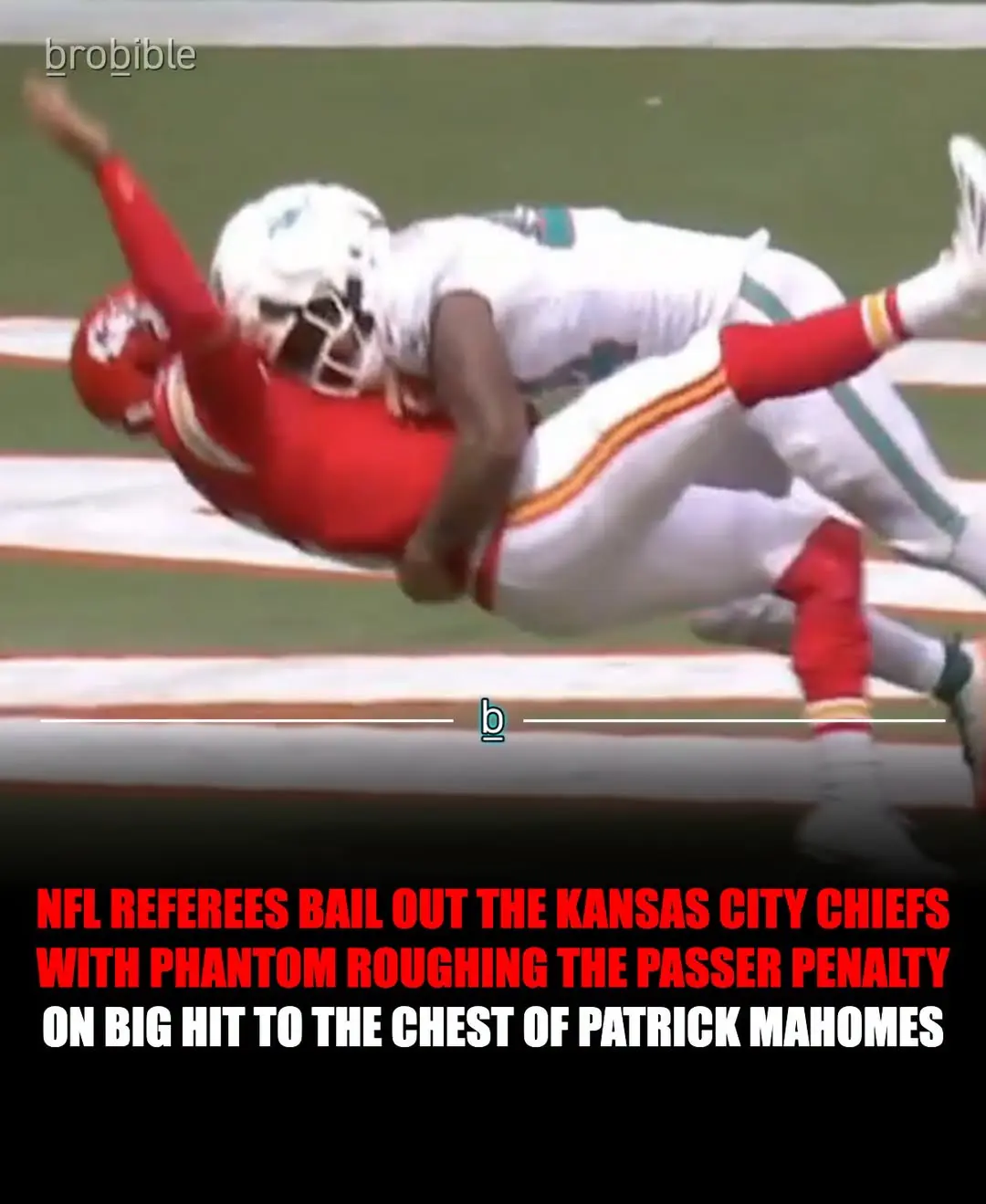
On third-and-nine from the Kansas City 5-yard line, Mahomes dropped back looking for Rashee Rice.
Miami edge rusher Chop Robinson exploded into the pocket.
Mahomes released the football.
Incomplete.
For a split second, it looked like Miami had produced the stop it desperately needed.
Then the flags appeared.
Roughing the passer.
And almost immediately, social media erupted.
“Mahomes gets another call.”
“The Chiefs got bailed out again.”
“How is a defender supposed to tackle a quarterback?”
Those reactions spread quickly because the hit didn't involve obvious contact to Mahomes' head or knees.
Robinson arrived as Mahomes released the football and drove through the quarterback.
But officials determined that Robinson landed on Mahomes with his body weight — the key element behind the roughing-the-passer decision.
That's where the debate begins.
Under modern NFL quarterback-protection rules, defenders cannot simply drive a passer into the ground and land on him with their full body weight.
One analysis of the play therefore described the call as essentially textbook under the current interpretation of the rule.
Others saw it very differently.
They pointed to Robinson appearing to extend his arms as he went down, seemingly attempting to reduce the amount of weight landing directly on Mahomes.
Afterward, Robinson himself indicated that he was trying to use the technique he'd been coached to use.
So was Kansas City really “bailed out”?
There's another detail that makes that argument more complicated.
Miami was also flagged for defensive holding on the same play.
That matters enormously.
Even without the controversial roughing-the-passer call, the defensive holding penalty would have resulted in a Kansas City first down.
In other words, saying the roughing flag alone prevented a Chiefs punt leaves out a crucial part of the play.
But that didn't stop the controversy.
Because this argument has become bigger than one penalty.
It's about perception.
And when Patrick Mahomes is involved, perception can become explosive.
For years, rival fans have argued that elite quarterbacks — particularly Mahomes — receive protection that other quarterbacks don't always seem to get.
Every questionable flag becomes evidence.
Every borderline hit becomes another debate.
Every time Mahomes looks toward an official after contact, social media immediately notices.
That doesn't prove favoritism.
But it explains why one yellow flag can ignite such an enormous reaction.
The NFL has intentionally created rules designed to protect quarterbacks.
There's an obvious reason.
Quarterbacks are frequently hit while they're vulnerable.
They're looking downfield.
Their throwing motion leaves them exposed.
And defenders weighing more than 250 pounds can arrive at full speed.
The league doesn't want quarterbacks driven unnecessarily into the turf.
But defenders face an almost impossible challenge.
They're asked to attack aggressively enough to pressure the quarterback while simultaneously controlling exactly how their bodies land after making contact at full speed.
That's why the Robinson hit became such a perfect example of the controversy surrounding modern roughing-the-passer enforcement.
From one angle, it looked like a defender doing his job.
From another, it fit the rule officials have been instructed to enforce.
Both things can be true.
And that's exactly why fans are frustrated.
Kansas City eventually turned the extended possession into a field goal, pushing the advantage to 17–10.
The Chiefs later pulled away and won 24–10.
Mahomes finished with 246 passing yards and two touchdowns, while Kansas City improved to 3–0.
But the penalty remained one of the game's biggest talking points.
Because football fans aren't simply arguing about whether Robinson committed a foul.
They're arguing about something much larger:
What is a defensive player actually supposed to do?
If Robinson arrives a fraction of a second later, he risks being penalized for a late hit.
If he goes too low, that's illegal.
If he makes contact with the head or neck area, that's illegal.
And if his momentum carries his body onto the quarterback?
That can be roughing too.
So defenders are expected to attack the quarterback at full speed — and somehow turn gravity off immediately afterward.
That's where criticism of the rule has become understandable.
But blaming Mahomes personally is a different question.
Mahomes didn't throw the flag.
The officials did.
And the rule itself exists regardless of which quarterback is standing in the pocket.
The legitimate debate isn't whether Mahomes somehow controls referees.
It's whether officials apply quarterback-protection rules consistently across every game and every quarterback.
That's the standard fans actually want.
Consistency.
If this is roughing when Mahomes gets hit, it should be roughing when any quarterback gets hit the same way.
If officials decide Robinson's attempt to brace himself was sufficient, then similar plays should be treated the same way elsewhere.
That's how confidence in officiating is built.
Not by eliminating controversial calls.
That's impossible.
By making the standard predictable.
Miami had opportunities beyond this one snap.
The Dolphins couldn't finish enough drives, while Kansas City eventually made the decisive plays and walked away with a 24–10 victory.
But none of that makes the controversy disappear.
Because this wasn't merely another incomplete pass.
It became another chapter in one of the NFL's loudest ongoing debates:
Are quarterbacks being protected too aggressively — and is that protection being applied equally?
For Dolphins fans, the Robinson flag felt brutal.
For those defending the officials, it was simply the modern roughing-the-passer rule being enforced.
And for everyone watching?
It was another reminder that when Patrick Mahomes, the Chiefs and a controversial yellow flag appear in the same moment, the argument is almost guaranteed to last longer than the play itself.
Was it textbook roughing — or has tackling an NFL quarterback become nearly impossible? 🏈🔥
#PatrickMahomes #KansasCityChiefs #MiamiDolphins #ChiefsKingdom #NFL #NFLNews #ChopRobinson #Mahomes #Football #NFLRefs