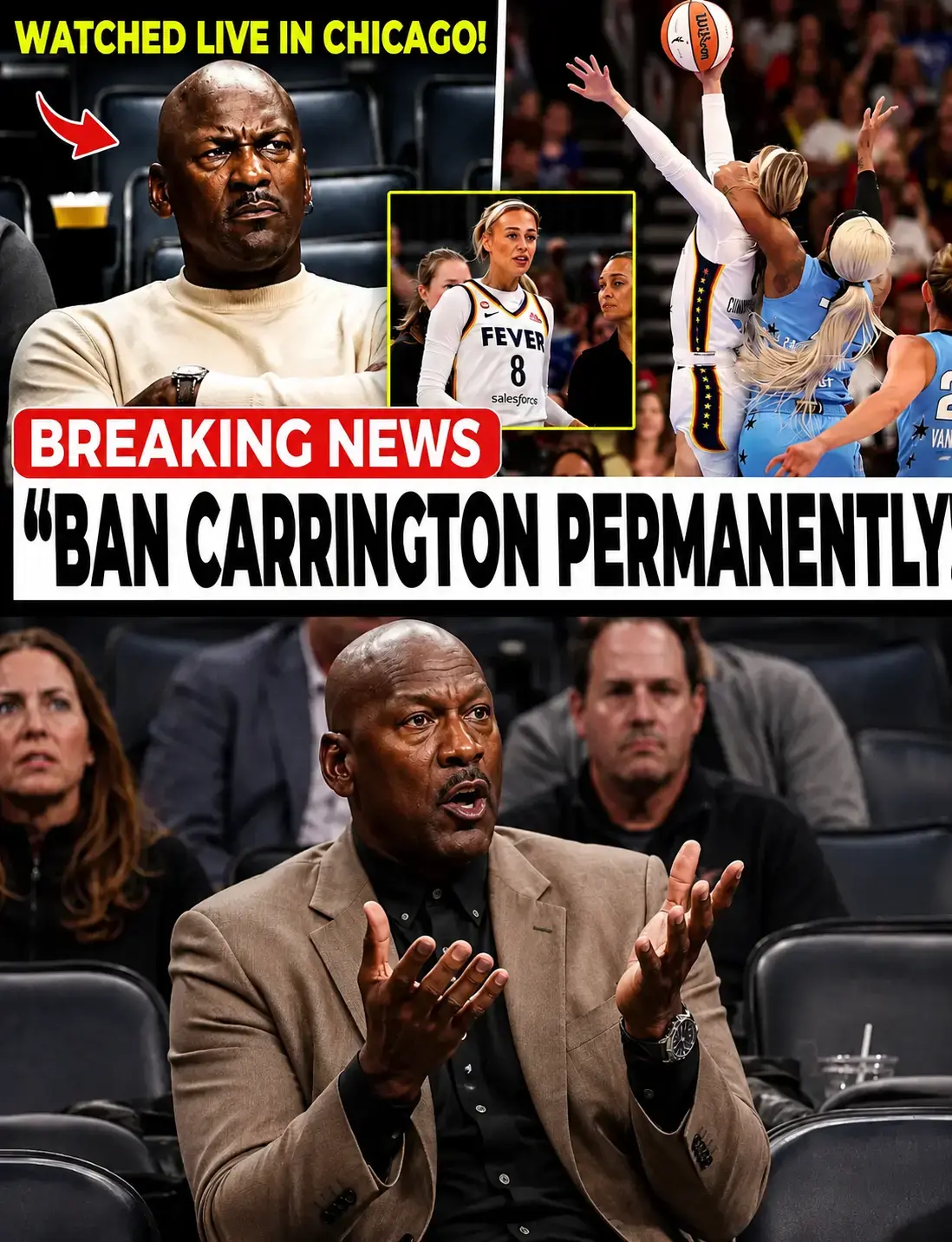
🚨🏀 MICHAEL JORDAN–WNBA VIRAL CLAIM EXPLODES AFTER DIJONAI CARRINGTON’S BRUTAL FOUL ON SOPHIE CUNNINGHAM — The WNBA is facing another explosive controversy after Chicago Sky guard DiJonai Carrington was ejected for a Flagrant 2 foul on Indiana Fever’s Sophie Cunningham, only for the confrontation to intensify when Carrington posted “WHITE PRIVILEGE” and tagged the Fever shortly afterward. The incident immediately ignited arguments over race, officiating and accountability, while Caitlin Clark was pulled into the chaos through a separate technical-foul controversy. Now viral posts are claiming Michael Jordan has entered the fight and “destroyed” the WNBA over its handling of the situation. But while the Carrington-Cunningham confrontation is very real, there is currently no reliable evidence confirming that Jordan issued the dramatic statement being attributed to him.

CHICAGO — What began as a fast-break layup suddenly became one of the most controversial moments of the WNBA season.
Sophie Cunningham was attacking the basket during Indiana’s matchup against Chicago when DiJonai Carrington chased the play from behind.
Carrington attempted to stop the transition opportunity.
Instead, she made significant contact around Cunningham’s head and neck.
Cunningham crashed to the floor.
Within seconds, she was back on her feet.
And she was furious.
The Indiana guard immediately moved toward Carrington before teammates and others stepped between the two players.
Officials reviewed the play.
Their decision was decisive.
Carrington’s foul was upgraded to a Flagrant 2, resulting in an automatic ejection.
Indiana eventually defeated Chicago 90-86.
But the final score quickly became secondary.
Because the confrontation was only beginning.
“WHITE PRIVILEGE” CHANGED THE ENTIRE CONVERSATION

Shortly after her ejection, Carrington posted two words on social media:
“WHITE PRIVILEGE.”
She also tagged the Indiana Fever.
Almost instantly, a basketball controversy became something much larger.
Fans began debating whether Carrington was accusing officials of treating Cunningham differently because she is white.
Others questioned whether the post was connected to Cunningham avoiding additional punishment after getting back up and confronting Carrington.
Cunningham rejected the racial framing after the game.
She pointed toward her own previous ejection and argued that race did not need to become part of the conversation.
Carrington later clarified an important point.
She said she had never claimed the Flagrant 2 assessment itself was an example of white privilege.
She also defended her understanding of the term and emphasized her academic background studying psychology and African-American/Black Studies.
But she did not immediately provide a complete alternative explanation for exactly what the original post was referencing.
That ambiguity ensured the controversy continued.
CARRINGTON SAYS THE FOUL WAS NEVER INTENTIONAL
Carrington subsequently addressed the play itself.
Her explanation was straightforward.
She said she was trying to prevent an uncontested layup.
According to Carrington, attempting that type of defensive play is consistent with how she has competed throughout her career.
She acknowledged that the resulting contact was unfortunate.
But she rejected the suggestion that she deliberately targeted Cunningham.
Carrington had also recently returned from injury and suggested her timing or elevation may not have been where she wanted it.
Her central message remained clear:
The contact happened.
The result was serious.
But she said hurting Cunningham was not the objective.
That interpretation received some support from an unexpected person.
Indiana head coach Stephanie White said she did not believe Carrington intentionally attempted to hit Cunningham across the neck.
White nevertheless agreed that the Flagrant 2 ruling was appropriate because of what actually occurred on the play.
That distinction matters.
Intent and outcome are not necessarily identical.
CUNNINGHAM SAW IT VERY DIFFERENTLY

Cunningham was considerably less forgiving.
She described the foul as unnecessary and said she believed it was intentional.
Cunningham also noted that she had essentially no personal relationship or existing conflict with Carrington.
Her reaction reflected exactly what viewers had witnessed immediately after the collision.
She was not prepared to remain on the floor quietly.
She got up.
She confronted Carrington.
And afterward, she suggested Carrington was looking for attention.
Those comments intensified an already volatile situation.
Now there were multiple disagreements happening simultaneously.
Was the foul intentional?
Was the ejection correct?
Should Cunningham have received a technical foul for her reaction?
And what exactly did Carrington mean by “WHITE PRIVILEGE”?
CARRINGTON RAISED A DIFFERENT QUESTION: CONSISTENCY
When Carrington later discussed the incident, she shifted attention toward consistency in officiating.
She argued that similar situations should be treated consistently regardless of a player’s identity, jersey, skin color, the score or the importance of the game.
That is materially different from claiming the Flagrant 2 itself happened because Cunningham is white.
Carrington accepted that she committed the foul.
Her broader argument centered on whether players receive equal treatment for the foul, the reaction afterward and other confrontations across the league.
Whether fans agree with that argument is another matter.
But accurately describing what she said is essential.
THEN CAITLIN CLARK WAS PULLED INTO THE CHAOS
As if the Carrington-Cunningham confrontation were not enough, Caitlin Clark experienced her own officiating controversy during the same game.
Clark was assessed a technical foul after making contact with an official when she was forced out of bounds.
At the time, it represented her eighth technical of the season and therefore carried the possibility of an automatic one-game suspension.
Clark maintained that the contact was accidental.
She said nothing had been verbally exchanged and expressed hope that the league would review the decision.
Stephanie White was even more direct.
She called the technical a bad call.
Once again, the Fever found themselves at the center of an officiating debate.
And once Clark’s name entered the story, attention multiplied.
WHY MICHAEL JORDAN’S NAME SUDDENLY APPEARED
Then came perhaps the most dramatic claim of all.
Posts began circulating suggesting Michael Jordan had responded to the controversy and delivered a devastating criticism of the WNBA.
Some versions portrayed the basketball legend as defending Cunningham.
Others suggested Jordan demanded stronger punishment for Carrington.
Still others framed his supposed intervention as a direct attack on the league’s leadership.
There is one major problem:
No reliable evidence currently establishes that Michael Jordan made those statements.
No authenticated Jordan statement supporting the viral wording has emerged.
That distinction is crucial.
Jordan is one of the most recognizable basketball figures in history.
Attaching his name to a WNBA controversy immediately makes the story dramatically larger.
But popularity does not authenticate a quotation.
Until an official statement, recording or reliable report establishes Jordan’s involvement, the claim should remain exactly what it currently is:
An unverified viral narrative.
THE REAL INCIDENT DOESN’T NEED TO BE EXAGGERATED
The strange part is that the verified story is already explosive.
Carrington genuinely committed a foul that officials upgraded to Flagrant 2.
She genuinely was ejected.
Cunningham genuinely confronted her afterward.
Carrington genuinely posted “WHITE PRIVILEGE” while tagging Indiana.
Cunningham genuinely rejected the racial framing.
Carrington genuinely said the foul was not intentional.
And Caitlin Clark genuinely became involved in a separate technical-foul controversy during the same game.
Those events provide more than enough material for a serious discussion about officiating, player safety and league discipline.
Inventing a Michael Jordan intervention only distracts from what actually happened.
WAS THE FLAGRANT 2 ENOUGH?
That question continues to divide fans.
A Flagrant 2 represents one of basketball’s strongest in-game punishments.
It removes the player immediately.
Officials determined Carrington’s contact met the necessary standard.
But some fans have argued that additional league discipline should follow whenever dangerous contact involves a player’s head or neck.
Others emphasize that basketball is a fast, physical sport and warn against automatically interpreting every dangerous collision as deliberate.
Stephanie White’s assessment captures that tension particularly well.
She did not characterize Carrington as intentionally attempting to injure Cunningham.
But she still believed the Flagrant 2 was the correct ruling.
Cunningham disagreed on intent.
Carrington rejected Cunningham’s interpretation.
That leaves fans with competing perspectives from the people directly involved.
RACE HAS NOW BECOME PART OF A BASKETBALL ARGUMENT
Carrington’s social-media post ensured the incident would not remain solely about basketball.
Questions surrounding race and differential treatment are complicated.
They cannot be resolved simply by replaying one foul.
Carrington has argued for consistency.
Cunningham has argued that race should not have been introduced into this particular situation.
Those are distinct positions.
The debate surrounding them has subsequently expanded far beyond the players themselves.
Commentators, former athletes and fans have offered competing interpretations.
Some believe Carrington raised a legitimate question about how different players are perceived.
Others believe her post unnecessarily racialized a correctly assessed basketball penalty.
That disagreement is unlikely to disappear quickly.
THE WNBA’S BIGGEST CHALLENGE MAY BE TRUST
Underneath the arguments lies a broader issue.
Fans want consistency.
Players want consistency.
Coaches want consistency.
And when similar-looking incidents appear to produce different outcomes, accusations of favoritism or unequal treatment inevitably follow.
That is not unique to the WNBA.
Every major professional sports league deals with disputes surrounding officiating and discipline.
But the enormous attention currently surrounding Indiana makes every decision involving Clark, Cunningham and their opponents considerably more visible.
One controversial call can become a national story.
One social-media post can turn a foul into a cultural debate.
And one fabricated celebrity quote can transform that debate again.
WHAT ACTUALLY REMAINS AFTER THE NOISE
Strip away the viral exaggeration and the facts remain dramatic.
DiJonai Carrington made dangerous contact with Sophie Cunningham during a transition play.
Officials reviewed it.
They assessed a Flagrant 2.
Carrington was ejected.
Cunningham believed the foul was intentional.
Carrington said it was not.
Carrington subsequently posted “WHITE PRIVILEGE” and later clarified that she was not claiming the Flagrant 2 assessment itself represented white privilege.
Those are the facts that can form the basis of a legitimate debate.
Michael Jordan supposedly “destroying” the WNBA cannot — at least not without evidence that he actually entered the controversy.
For the league, that may be the larger lesson.
The WNBA is receiving unprecedented attention.
With that attention comes scrutiny, disagreement and misinformation.
The Carrington-Cunningham confrontation did not require an invented twist to become one of the season’s most talked-about incidents.
What actually happened was controversial enough.
And the arguments it triggered — about player safety, officiating, race and accountability — are likely to continue long after the final whistle.
DISCLAIMER: The Flagrant 2 foul, Carrington’s ejection, her “WHITE PRIVILEGE” social-media post and the subsequent comments from Carrington, Cunningham and Stephanie White are documented events. However, viral claims that Michael Jordan personally attacked the WNBA or demanded additional punishment for Carrington have not been reliably verified and are not presented as fact in this article.